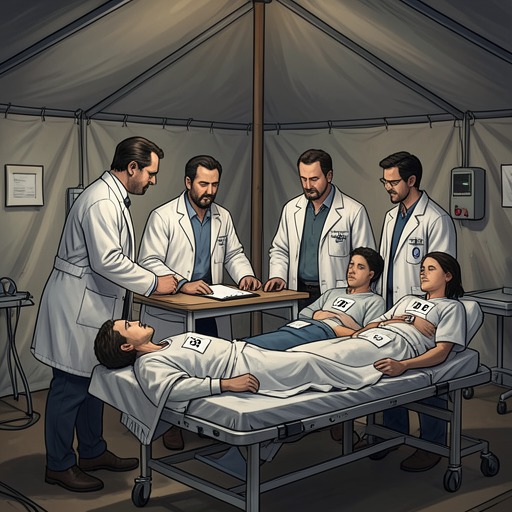
Institute of Medicine Recommendations on Disaster-Care Ethics
Five Days at MemorialThe Institute of Medicine Recommendations on Disaster-Care Ethics draw a firm boundary between allocating scarce medical resources and intentionally hastening death. They recognize that disasters may require limits on treatment, while insisting that emergency care remain guided by duties to patients, fairness, and accountable decision-making. In the wake of Hurricane Katrina and the controversy surrounding Anna Pou, the recommendations address not only what clinicians may do in a crisis, but also who should shape the rules and how those rules should govern triage.
The Boundary Between Triage and Hastened Death
A year after Anna Pou’s campaign for legal protection for medical workers, and again three years later, disaster experts convened by the Institute of Medicine considered the question of euthanasia in guidance for policymakers and the public. Their conclusion was categorical: “Neither the law nor ethics,” they wrote, “support the intentional hastening of death, even in a crisis.” The statement distinguishes decisions about distributing limited treatment from deliberately causing a patient’s death; emergency conditions do not erase that distinction.
The recommendations emerged amid public debate over whether extraordinary circumstances require exceptional moral rules. A bioethicist who was not part of the expert group argued instead that exceptional situations should prompt an especially deep commitment to fundamental values. The Institute’s position likewise rejects the idea that scarcity itself authorizes intentional hastening of death, while recognizing that scarcity can make some treatment decisions unavoidable.
Fair Allocation and DNR Orders
The Institute’s 2012 report supported public involvement in developing guidelines for dividing medical resources during disasters. Drawing on Katrina and other cases, its authors acknowledged that crisis conditions can justify limiting access to scarce treatments, but emphasized that medical providers retain duties to care for patients, treat them fairly, and steward available resources. The earlier Institute report also addressed do-not-resuscitate orders, concluding that they are not useful parameters for disaster triage: they express advance planning and personal preferences about end-of-life care, not an accurate estimate of a patient’s chances of survival.
That distinction matters because an instruction not to perform resuscitation if breathing or heartbeat stops does not, by itself, mean a patient should be denied rescue or placed last for evacuation. At Memorial Medical Center, doctors made DNR patients the last group to be evacuated. A patient’s daughter later explained that when she agreed to her mother’s DNR order, she had not understood it to mean “do not rescue”; she had the order canceled, and her mother was moved to safety. The episode shows how a medical instruction with a limited purpose can be misapplied when it becomes a shortcut for ranking whose life merits help.
Procedures, Public Participation, and Accountability
When emergency conditions require limits on scarce treatments, the Institute’s experts called for decisions to be transparent, consistent, proportionate to the degree of shortage, and accountable. These criteria make the allocation process itself part of ethical care: comparable cases should not be handled by ad hoc or hidden rules, and the stringency of restrictions should correspond to the actual scarcity. The report’s support for public participation also places guideline-making beyond the sole discretion of clinicians or administrators, although gathering public views does not automatically resolve disagreements or ensure that policymakers use what they hear.
The recommendations connect fairness to the conditions in which patients encounter disaster response. Before Katrina, many New Orleans residents had no means of leaving the city, while ambulances were immobilized in traffic and some were redirected to the Superdome. Within hospitals, patients’ medical dependence and DNR status could shape access to evacuation. The Institute’s emphasis on fair treatment and meaningful public involvement bears on how such rules are designed and scrutinized, rather than treating a patient’s vulnerability or a label in a chart as a sufficient measure of expected benefit.
Katrina as an Ethical Test
The contrast between hospitals during Katrina sharpened the problem the recommendations address. Charity Hospital endured flooding, loss of power and basic services, and a difficult evacuation that continued until September 2; approximately twice as many patients were present across its two campuses as at Memorial, yet fewer than ten died. Staff accounts described continuing care in patients’ rooms and holding meetings every four hours, alongside a flashlight-lit talent show. Those details do not establish a simple comparison between institutions, but they demonstrate that catastrophic conditions alone do not determine how care is organized or what obligations staff recognize.
The Institute’s recommendations consequently reject both an unqualified promise that every treatment can always be provided and the inference that crisis permits abandonment or intentional killing. Their governing distinction is between ethically constrained allocation under genuine scarcity and the deliberate hastening of death. By pairing that boundary with duties of care, fair process, and public participation, the guidance treats disaster ethics as a question of institutional responsibility as well as bedside judgment.